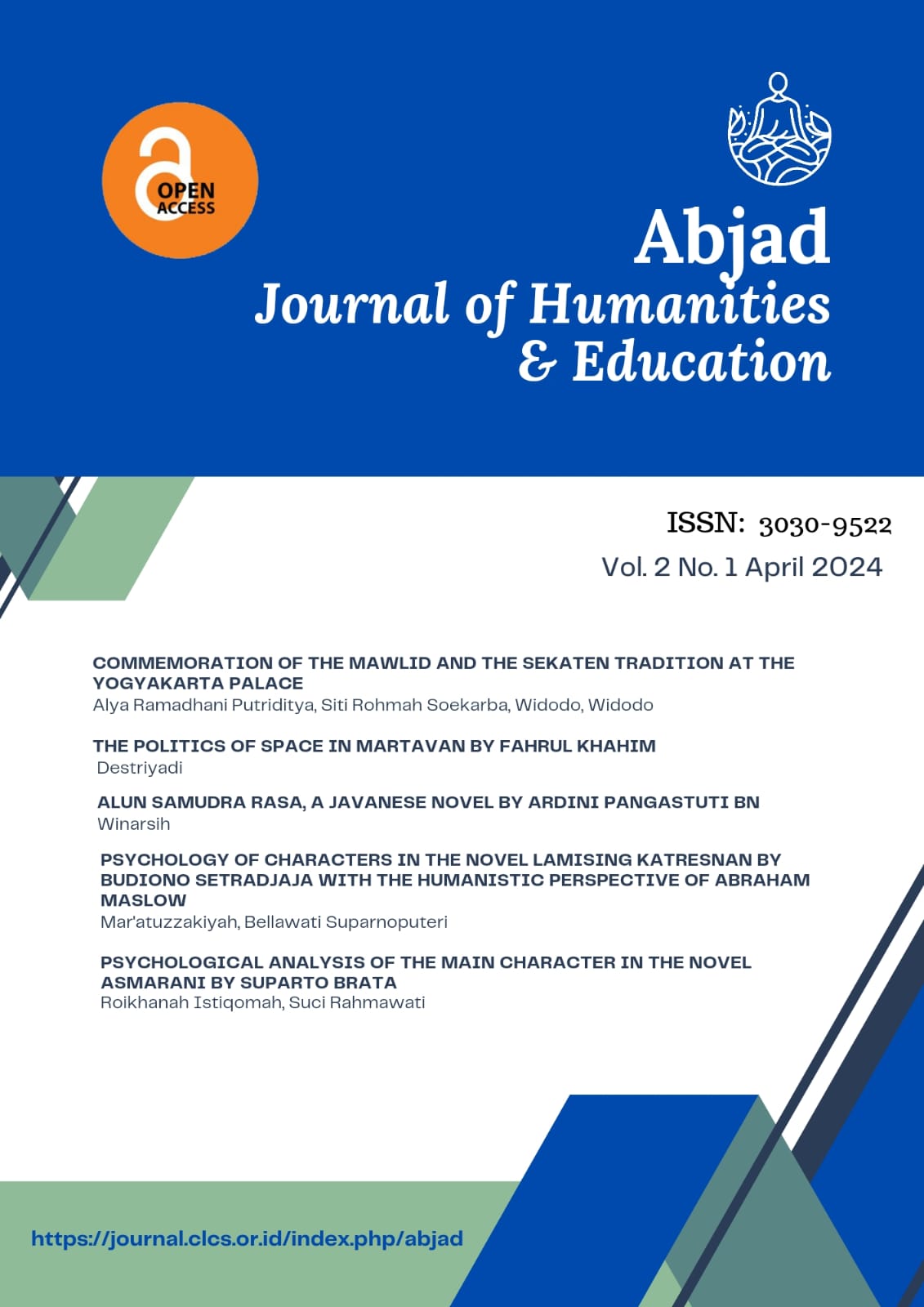
Commemoration of the Mawlid and the Sekaten Tradition at the Yogyakarta Palace
Keywords:
Sekaten tradition, Mawlid nabi, Yogyakarta PalaceAbstract
This article explores the Sekaten Tradition at the Yogyakarta Palace as a commemoration of Mawlid. The tradition has been alive and well in society since the Demak Kingdom. Initially, Islamic religious leaders used traditional and religious acculturation to attract people to gather as well as a means of preaching. In its development, the sekaten ceremony became a form of Javanese cultural identity commemorating Islamic religious holidays. In Indonesia, the sekaten tradition is a tradition that lives and develops in society. Sekaten is no longer a tribal identity, but over time, it has become a tradition carried out by some people and a marker of respect for the Islamic holiday, namely the birth of the Prophet. The shift in function from preaching media to the realm of ceremonies occurs not only in the sekaten tradition but also in other traditions. Through a cultural approach, this research shows how Sekaten is a means of expressing the traditions of Yogyakarta society. By analyzing its history, meaning and function today, Sekaten can live across the ages with dynamic forms and changes in function. This research shows that the sekaten tradition can provide a line of cultural order that is followed and adhered to by the community in the eco-bio-cultural realm. The resilience of Javanese culture, which is acculturated to the religion of the people who own it, can become a means to exist in various domains of life beyond time. This research expresses today's sekaten tradition as a means of existence for rulers and society through culture. Javanese traditions instituted by the palace as a source and patron of culture will become icons and cultural forces. The Sekaten tradition is one of the sacred traditions in Yogyakarta. This tradition was created as a form of respect for the Prophet Muhammad.
Downloads
References
Adji, F. T. (2008). Konsep Religi dan Nilai Historis dalam Kakawin Brahmanda Purana. In Sintesis (Vol. 6, Nomor 2).
Animawan, A., & Koentjoro, K. (2021). Ngemong Raos: Aesthetic Leadership Role of Panjak Juru Kendhang in Javanese Gamelan. Malaysian Journal of Music, 10(2), 1–12. https://doi.org/10.37134/mjm.vol10.2.1.2021
Aritonang, J. S. (2000). Christiannity In Javanese Culture and Sosiety Book Title : A History of Christianity in Indonesia. Brill. https://doi.org/103.181.255.10
Dickson, W. R. (2022). Sufism and Shari‘a: Contextualizing Contemporary Sufi Expressions. Religions, 13(5). https://doi.org/10.3390/rel13050449
Frishkopf, M. (2022). Textual Dimensions of the Public Ḣaḋra in Egyptian Sufism. Muzikoloski Zbornik, 58(1), 61–99. https://doi.org/10.4312/mz.58.1.61-99
Goldhahn, J., Labarakwe, S. L., Skoglund, P., & Westergren, E. (2021). ‘I Have Done Hundreds of Rock Paintings’: On the Ongoing Rock Art Tradition among Samburu, Northern Kenya. Cambridge Archaeological Journal, 31(2), 229–246. https://doi.org/10.1017/S095977432000044X
Hendrawan, Y., Anniza, K. N., Prasetyo, J., Damayanti, R., & Djoyowasito, G. (2020). Effect of plant sound wave technology to increase productivity of mustard greens (Brassica juncea L.). IOP Conference Series: Earth and Environmental Science, 524(1), 012012. https://doi.org/10.1088/1755-1315/524/1/012012
Hendrawan, Y., Putra, A. H., Sumarlan, S. H., & Djoyowasito, G. (2020). Plant acoustic frequency technology control system to increase vegetative growth in red-lettuce. TELKOMNIKA (Telecommunication Computing Electronics and Control), 18(4), 2042. https://doi.org/10.12928/telkomnika.v18i4.14158
Hoekema, A. G. (2014). “A wound in the heart”: Religion and religiosity in the work of the Indonesian novelist Ayu Utami. Exchange, 43(2), 132–152. https://doi.org/10.1163/1572543X-12341314
Irawanto, D. W., & Ramsey, P. L. (2011). Paternalistic Leadership and Employee Responses in Javanese Culture. Gadjah Mada International Journal of Business, 13(2), 185. https://doi.org/10.22146/gamaijb.5490
Iswanto, A. (2018). Memahami Kompleksitas Transformasi Agama-agama di Jawa melalui Teks. Manuskripta, 8(1). https://doi.org/10.33656/manuskripta.v8i1.106
Iswanto, A. (2019). Menelisik Sosok dan Ajaran Sunan Kalijaga Melalui Manuskrip. Manuskripta, 9(1). https://doi.org/10.33656/manuskripta.v9i1.138
Kuehn, S. (2023). Contemporary Art and Sufi Aesthetics in European Contexts. Religions, 14(2). https://doi.org/10.3390/rel14020196
Kurniawati, A., Yuniarno, E. M., Suprapto, Y. K., & Soewidiatmaka, A. N. I. (2023). Automatic note generator for Javanese gamelan music accompaniment using deep learning. International Journal of Advances in Intelligent Informatics, 9(2), 231. https://doi.org/10.26555/ijain.v9i2.1031
Manik, H. F. G. G., Christanti, R., & Setiawan, W. (2022). Knowledge management and community-based enterprise: an initiative to preserve the shadow puppet traditional knowledge in Yogyakarta, Indonesia. VINE Journal of Information and Knowledge Management Systems. https://doi.org/10.1108/VJIKMS-11-2021-0265
Manuba, i. b. putera, Sd, trisna kumala, & Setijowati, A. (2015). Peta Sastra Indonesia Sastrawan Jawa Timur. litera.
Muzammil, S., Taufik, E. T., Mufidatunrofiah, S., & Al Amin, N. U. (2022). The Adaptability of Pesantren in Indonesia During The New Normal Era. JOURNAL OF INDONESIAN ISLAM, 16(2), 426. https://doi.org/10.15642/JIIS.2022.16.2.426-454
Naredia, S. P. (2023). Symbolic Meanings of Noble Values in Srandul Art in Kampung Bumen, Kotagede, Indonesia. International Society for the Study of Vernacular Settlements, 10(8), 39–47. https://doi.org/10.61275/ISVSej-2023-10-08-03
Negoro, S. S. (2001). Upacara Tradisional dan Ritual Jawa. Buana Raya.
Nofrima, S., Sudiar, S., & Purnomo, E. P. (2021). How Javanese Culture Shaping Political Ideology (Case Study of the People in Yogyakarta). Jurnal Ilmiah Peuradeun, 9(2), 435. https://doi.org/10.26811/peuradeun.v9i2.500
Noortyani, R., Mu’in, F., & Amelia, R. (2023). Symbolic Communications in the Traditional Wedding Rituals of the Banjar Ethnic Community, Indonesia. International Society for the Study of Vernacular Settlements, 10(10), 154–178. https://doi.org/10.61275/ISVSej-2023-10-10-11
Nugroho, A. (2019). Indigenous islam and politics: The authenticity of islamic government of yogyakarta palace. Humanities and Social Sciences Reviews, 7(4), 1372–1377. https://doi.org/10.18510/hssr.2019.74191
Nugroho, S. (2019). Pemenuhan Kebutuhan Hidup Masyarakat Jawa dalam Serat Sanasunu Karya R.Ng. Yasadipura II : Kajian Antropologi Sastra. Alayasastra, 15(1), 13. https://doi.org/10.36567/aly.v15i1.314
Rashidian, M., Hussain, R., & Minichiello, V. (2013). ‘My culture haunts me no matter where I go’: Iranian-American women discussing sexual and acculturation experiences. Culture, Health & Sexuality, 15(7), 866–877. https://doi.org/10.1080/13691058.2013.789128
Ricci, R. (2009). Conversion to Islam on Java and the Book of One Thousand Questions. 165(1), 8–31.
Rosmiati. (2016). Gaya Bahasa dalam Nyanyian Rakyat Kau-Kaudara Masyarakat Muna. Jurnal Humanika, 1(16), 21.
Salamensky, S. I. (2013). Culture, Memory, Context: Reenactments of Traumatic Histories in Europe and Eurasia. International Journal of Politics, Culture, and Society, 26(1), 21–30. https://doi.org/10.1007/s10767-013-9138-7
Sila, M. A. (1970). The Festivity of Maulid Nabi in Cikoang, South Sulawesi: Between Remembering and Exaggerating the Sprit of the Prophet. Studia Islamika, 8(3), 1–56. https://doi.org/10.15408/sdi.v8i3.680
Soehardi. (2012). Nilai-Nilai Tradisi Lisan Dalam Budaya Jawa. Jurnal Humaniora, 14(3), 1–13. https://doi.org/10.22146/jh.v14i3.763
Sulfinadia, H., Roszi, J. P., Rosdialena, R., Suryani, E., & Fitri, A. (2023). Implementation of Aqiqah in the Bulan Maulid in Nagari Padang Laweh West Sumatra Perspective’Urf. Al-Istinbath: Jurnal Hukum Islam, 8(2 November), 465. https://doi.org/10.29240/jhi.v8i2.6800
Sumarno, M. S. (2013). Sinkretisme Jawa-Islam dalam Serat Wirid Hidayat Jati dan Pengaruhnya Terhadap Ajaran tasawuf di Jawa Abad 19. Journal Pendidikan Sejarah.
Suyatno, S., Tjokronegoro, H. A., Merthayasa, I. G. N., & Supanggah, R. (2016). Analysis of Onstage Acoustics Preference of Musicians of Traditional Performance of Javanese Gamelan Based on Normalized Autocorrelation Function. Journal of Engineering and Technological Sciences, 48(5), 571–583. https://doi.org/10.5614/j.eng.technol.sci.2016.48.5.5
Thohri, M., & Hadisaputra, P. (2022). Ulumuna. 26(1), 1–22.
Tod Jones. (2015). Kebudayaan dan Kekuasaan di Indonesia. In Kebijakan Budaya selama abad ke-20 hingga era reformasi.
Utomo, S. S. (2002). Upacara Daur Hidup Adat Jawa. Effar Offset.
Wain, A. (2021). The Kubrawī and early Javanese Islam: Re-assessing the significance of a 16th-century Kubrawī silsila in the Sejarah Banten Ranté-Ranté. Indonesia and the Malay World, 49(143), 42–62. https://doi.org/10.1080/13639811.2021.1875658
Williams, M. S., & Liu, C. (2023). Who Am I and Where Do I Belong? The Impact of Heritage Cultural Identity Salience on Immigrant Workers Acculturation Strategies. Journal of International Migration and Integration, 24(2), 793–815. https://doi.org/10.1007/s12134-022-00978-7
Wiryanto, Primaniarta, M. G., & Mattos, R. L. de. (2022). Javanese ethnomathematics: Exploration of the Tedhak Siten tradition for class learning practices. Journal on Mathematics Education, 13(4), 661–680. https://doi.org/10.22342/jme.v13i4.pp661-680
Wu, J., Luo, W., Chen, J., Lin, R., & Lyu, Y. (2023). Design Ritual into Modern Product: A Case Study of Chinese Bronze Ware. Sustainability (Switzerland), 15(17). https://doi.org/10.3390/su151712747
Zustiyantoro, D., Nuryatinÿ, A., Supriyanto, T., & Doyin, M. (2022). Luwes dan Filosofis : Pertunjukan Wayang Dewaruci dalam Konsep Kasampurnan Suryomentaram. 22(2), 418–433.
Published
How to Cite
Issue
Section
Copyright (c) 2024 Authors

This work is licensed under a Creative Commons Attribution-NonCommercial 4.0 International License.